Secret Santicore 2011 Compilation

Jez over at Giblet Blizzard has completed the compilation of Secret Santicore 2011! It’s a free 10 MB PDF download, and has production values higher than many professionally produced publications. It’s fully illustrated as well. Minus the covers, there are 102 pages of content.

My regard should not be considered impartial, as my Weird Cult Generator is included.

Thanks also to Adam Watts, who provided my request, a wilderness stronghold generator on page 70 (I want more tools for wilderness stronghold creation based on my thoughts about power centers here).

Go, download, and thank Jez for his excellent work.

Spells by Reverse Engineering & Dissection

In a comment over at Gothridge Manor on a post about spells as treasure, Zzarchov mentioned that in his game (Neoclassical Geek Revival, or NGR) wizards can “learn” spells by reverse engineering magic items (destroying them in the process) or dissecting creatures with magic abilities. This mechanic could be thought of as a generalization of the rules for learning spells from scrolls (as the scroll is consumed). Reverse engineering is covered in NGR on page 12 (“Translate Magic”), though I don’t see any mention of dissection (I think it might have been a player innovation in one of his games).

NGR clearly owes a debt to D&D, but is not even close to compatible. Here is my D&D version of these ideas. Normally (Cook/Marsh Expert Rules page X51), spell research requires 1000 gp and 2 weeks of time per spell level. If you have a magic item that you are willing to destroy through reverse engineering, you can research a spell with effects similar to the item’s power. Instead of the normal costs, pay 100 gp and 1 day of time per spell level. Depending on the complexity of the spell, an intelligence check or 5 in 6 success situation roll may be required for complete (or even partial) success. Reverse engineering some magic items may be dangerous (save vs. spells to avoid or lessen the danger). Normal domain rules for spell research still apply, however. A magic-user cannot research a spell like cure light wounds, for example.

A newly dead creature with magic powers may also yield insight to spell research. The rules are similar to reverse engineering, but the corpse must be either newly dead or preserved in some way, and a lab (perhaps improvised) must be available. Costs are 500 gp and 1 day of time per spell level. Vivisection will increase chances, but may result in vengeful spirits. (I’m not sure if 500 gp is the right cost level for spell research through dissection; perhaps it should be lower.)

The discussion of counterspells in NGR also gave me an idea for why magic-users might be hesitant to share their knowledge like modern scientists: a magic-user who has been taught a spell by another magic-user (or copied it from their spell book) has insight into that particular method of casting, and can counter it in some way. Thus, if you teach someone your spell, you are also exposing your weaknesses. I’m not sure about game mechanics that might work well with B/X D&D for this yet, but I like the idea and will try to run with it at some point.

(Note: page references are to the “lion” printing of NGR.)

Thief Draft

I think it may be an OSR rite of passage to redesign the thief class. Here is my entry.

First, the literature review. I have been heavily influenced by Robert Fisher’s On thief skills in classic D&D, Philotomy’s musings on Thieves & Thief Skills, Matthew James Stanham’s article Thieving Ability (also discussed here). The Jovial Priest has an interesting article, though I decided to go in a different direction (his 2d6 resolution table is too complicated for me, and his “favored skill” system introduces complexity during character creation). Also see Talysman’s recent thief. I’m also becoming quite fond of Talysman’s situation roll, as you can probably tell from my section on skills below. Grognardia’s thiefly thoughts post is also worth a read for a quick summary of why some people think the classic thief is problematic. The LotFP specialist (Grindhouse Edition free Rules & Magic page 10) must also be noted as an important replacement thief. I like how the d6 skills emphasize that all classes can attempt certain tasks (climb, hide, search, etc) even if the specialist is better at them, but I don’t like how those skills take up extra space on the character sheet and use a point-buy system, necessitating choice during character generation.

The Cook/Marsh Expert rules (page X8) suggest some ideas for extending thief skills for higher level play: climb overhangs, climb upside down, ventriloquism, powers of distraction, mimic voices. Some of my thief skills are based on these ideas, and I may work the ones I am not using into a later draft in some fashion (particularly the improved climbing abilities).

Flavor:

  • Thieves are masters of stealth. They are commandos, spies, assassins, infiltrators, and skulks. They solve problems by guile, cleverness, and trickery. They will never fight fairly if they can help it.

Most thief skills consume the resource of time (suggested by the B/X Blackrazor “automatic” thief). Absent distraction or complication, thieves will succeed if they are not rushed (time required is included with the skill description). Wearing any non-light armor (i.e., anything other than leather following the B/X rules) will result in penalties for the physical skills (likely a penalty of one or two on the situation roll, but specifics are by circumstance and referee ruling). I will probably formalize this through the encumbrance system. I use LotFP encumbrance rules, so it should be easy to base the penalty on the encumbrance level (see the free Rules & Magic book, pages 38 – 40).

Thieves use d6 for hit dice. They may use any weapon or armor. Since mobility, speed, and agility are important to thieves for many reasons, they rarely wear non-light armor. I use hit die based weapon damage (with 2DTH for dual wielding or two-handed weapons). So, thieves do d6 damage with weapons. They use the “medium” base attack bonus by level (shared with clerics). Though I’m not a fan of the “combat advantage” DPS super-strikers of 3E & 4E, I do like my thieves to be a bit more capable in combat than they are in the various early rule sets.

Regardless of level, all thieves have the following abilities:

  • Alertness: bonus to hearing noise (2 in 6 chance rather than the normal 1 in 6); this also makes the thief harder to surprise
  • Surprise attack: +4 to attack roll, double damage upon hit (in some ways this is the inverse of the alertness ability)

Skills are the essence of the thief class, and I have not neglected them. I am following my idea of giving the thief one awesome ability per level rather than many poor abilities all at once that develop slowly. This also fits my principle of introducing complexity slowly. I do think it is important to allow the thief to develop as levels are accumulated (this is why I am not following the B/X Blackrazor all-at-once automatic thief). The level advancement incentive is a big part of classic D&D play, and all the other core classes develop (cleric: turning & spells, fighter: attack bonus, magic-user: spells).

Thief skills by level (or roll d10 each level, re-rolling duplicates):

  1. Open locks (requires tools): Mundane locks take 1 turn to open. Complicated locks may require dice (5 in 6 succeeds, on failure dexterity save to avoid breaking the tools). Magical locks may not be opened.
  2. Move silently, 10’ per turn (20′ per turn is also possible but will likely require a dexterity save, or a 5 in 6 success probability, depending on circumstances)
  3. Hide in shadows, may not move
  4. Interpret languages, codes, and maps (5 in 6 success, on failure may only retry upon gaining a level)
  5. Climb walls, 10’ per turn, if distracted or attacked save or fall
  6. Voices: ventriloquism & mimicry
  7. Legerdemain: pilfer, distract, or amuse; can also be used to disable small mechanical traps (5 in 6 success, on failure dexterity save to avoid being caught)
  8. Brew poison: given 1 day and 100 gp, a thief can brew one dose of save-or-die poison sufficient to threaten the life of a human-sized opponent. How larger or smaller creatures react to poison is by referee ruling. 5 in 6 chance to identify and know effects of examined poisons. Other recipes (such as for a paralytic poison) can be found, or can be synthesized based on reverse-engineering an identified poison.
  9. Assassinate: successful surprise attack does damage in hit dice rather than hit points
  10. Use magic scrolls (5 in 6 success, on failure save vs. spells or backfire)

That’s right, if you roll for your skill, you could start with the assassinate or brew poison ability. I like that.

Am I missing any traits or abilities that are associated with the archetypal thief?

27 December 2011 edit: more good suggestions from Jeffro here.
11 February 2012 edit: added poison identification to the brew poison ability.
13 February 2012 edit: added reverse engineering to the poison ability.

Advanced Adventures


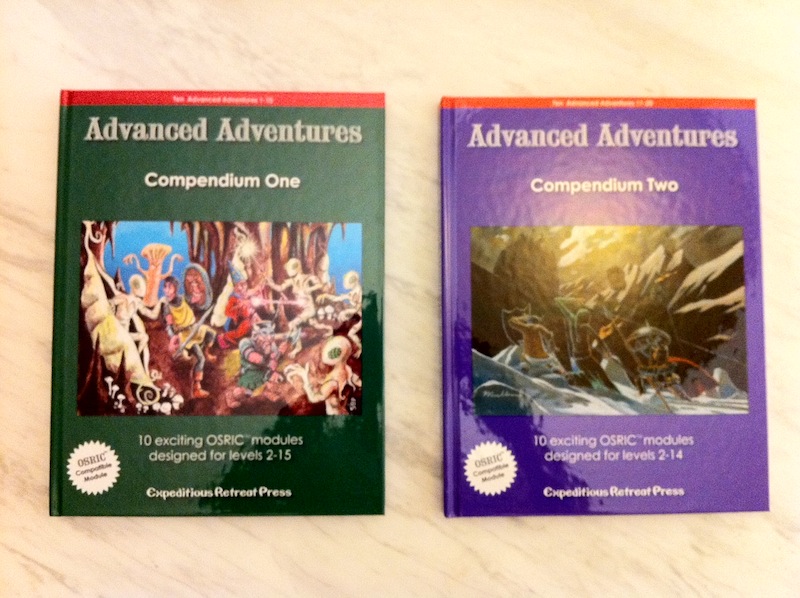
I took advantage of one of the recent Lulu sales to pick up the Advanced Adventures compilations (Compendium 1 and Compendium 2). They arrived at the beginning of the month, but I just now had the opportunity to page through them. They are beautiful books, and I can’t wait to use some of the adventures. I think Pod-Caverns of the Sinister Shroom will probably be the first I run, as a prelude to Demonspore (my players have already encountered a raiding party of toad people slavers on the surface). If you’re interested in the contents of the individual adventures, Silver Blade Adventures has a nice series of reviews. I can imagine that it’s going to take a long time for me to even read all this material, much less make use of it on the gaming table. With these and the older TSR modules I have acquired recently, I have a lot to work with.

The heft of a hardcover book feels much more satisfactory than the thin saddle-stapled form of the individual modules (though I don’t like to make it obvious what module I am running and a hardcover is more difficult to hide in a gaming binder). That being said, these collections are literally just the AA modules sandwiched between hard covers. There is no table of contents. There is no index. You have to perform a sequential page search to find anything. These compilations could have become much more than the sum of their parts if they had included things like collected appendices of all the new monsters. I think this is a lost opportunity.

Books are a form of information technology. More advanced books have tables of contents, indices, lists of works cited, collected appendices of common entities, and bibliographies. Books that lack these features are not as capable. Too often, digital publishers don’t understand the technical value of these traditional features, perhaps assuming that full text search is a replacement for a human-compiled index (it’s not). Digital publishers often don’t even make use of the unique capabilities of a digital format, such as hyperlinks and internal bookmarks. I have bought Kindle books that don’t even include a table of contents. Happily, this seems to be slowly getting better (for example, the Carcosa PDF is heavily bookmarked).

Speaking of Carcosa, I wish all paper publishers would follow the lead of LotFP and include a PDF with any hardcopy purchase. It is quite useful to be able to print out individual pages for game binders and easily crop images for player handouts.

Weird Cults

The request I got:

Dear Secret Santicore…
I’d like a table or set of tables for generating weird cults.
Thanks!

And here it is.


MARK II WEIRD CULT GENERATOR

(Use with caution. Service all parts every 30 days.)

Roll 10d10 and consult the tables in order.

Or, roll d10 for the number of tables to consult (let N be this number), and then roll Nd10 to decide which tables to consult and another Nd10 to determine the operative values.

Never, ever, roll on the animal table unless explicitly directed to by another table. Otherwise, bad things will happen. We don’t talk about what happened to those who used MARK I. Just be glad you got MARK II.


TABLE I: What do they worship?

  1. The idea of progress
  2. A demon lord
  3. The jealous, forgotten god of the chosen people
  4. Prince of animals (roll on animal table)
  5. The lord of Nod, the land of sleep and hallucination
  6. Deposed deified emperor from 1000 years ago (“Dark Augustus”)
  7. The universal life-force
  8. The new prophet
  9. Overlord of a rival state
  10. An ancient machine

TABLE II: What is their identifier?

  1. Animal tattoo on their back (roll on animal table)
  2. Fine silver ring, allowed to tarnish
  3. Ritual cross-hatch scars on upper arms
  4. Glass eye
  5. Secret handshake
  6. Green blood
  7. Nictitating eyelid
  8. Sharp teeth (either sharpened or naturally sharp)
  9. Hairless
  10. Verbal prayers of thanks to the patron upon any success

TABLE III: What is their ultimate goal?

  1. Extinction, but they want to take as many others with them as possible
  2. Accumulate souls for their account in hell
  3. To take back the underworld — men belong underground, monsters above
  4. Prepare the world for the ancient masters from the stars
  5. Immortality; each cell has part of the recipe, they seek each other out
  6. Enlightenment through extreme experiences
  7. Reforesting the great waste known as civilization
  8. Yellow is the sacred color, as much of the world as possible must be in this hue
  9. The end of warfare
  10. Reuniting two sundered worlds

TABLE IV: Who is in charge?

  1. Mad charismatic crackpot
  2. Demon, fae, or otherworldly being in human guise
  3. Explorer who found the fountain of youth
  4. Swindler, bilking the credulous
  5. Swindler, bilking the credulous, unaware that his teachings are true
  6. Ancient underground machine
  7. Prince of animals (roll on animal table for type)
  8. One of the PCs in a past life or before the amnesia
  9. An animate painting
  10. A telepathic idol of the ancients

TABLE V: What is their taboo?

  1. Must not eat vegetables
  2. Will not shake hands (it is polluting)
  3. If you meet their eyes, you will learn one of their secrets
  4. They must wash skin that sunlight touches
  5. Dead cultists must be ritually separated in buried in 6 different locations
  6. Must not start a fire
  7. Sexual abstinence
  8. Will eat nothing cooked
  9. Must not lie
  10. Must always have a clear mind; no intoxicants

TABLE VI: What is their secret power?

  1. Start and control fires — pyrokinesis
  2. Corpses speak to cultists
  3. Discipline of the body — ancient martial arts
  4. Preserve corpses indefinitely, either magically or scientifically
  5. None, though they believe they can summon demons
  6. Rust metal by touch
  7. Mind meld — they can read thoughts by touch
  8. Fertile — crops tended yield 2 to 3 times normal bounty
  9. Sympathetic magic — voodoo that works
  10. Influence animals (like the cleric’s turn undead ability)

TABLE VII: What is their ritual garb?

  1. Yellow robes
  2. Full armor with helm (antiques valued)
  3. Official magistrates — they actually run the 
  4. Wizard robes, full on stars and moons and pointy hats (they believe they are magic-users)
  5. Finely scented loin cloth
  6. Black tunic and sandals
  7. Masquerade masks
  8. Business formal — suit and tie or equivalent for time period
  9. Paramilitary uniforms
  10. Shape-changers — lycanthropes or other, ritual “garb” is their non-human form

TABLE VIII: What do their nameless rituals entail?

  1. Eating live animals (roll on animal table for type)
  2. Recitation of ancient sutras
  3. Silent meditation
  4. Ritual combat
  5. Human sacrifice
  6. Animal sacrifice (roll on animal table)
  7. Burning the sacred texts of rival cults
  8. Riddles
  9. Summoning
  10. Believer suicides

TABLE IX: Where do they hold their nameless rituals?

  1. Center for performing arts (amphitheater, boxing ring, etc)
  2. Ancient stone circle
  3. Fake ancient stone circle (they set it up)
  4. Ancient unearthed vessel
  5. Town hall — they run the place
  6. The home of a ritually slain family
  7. A natural glade under an overcast sky
  8. By running water to protect from hostile spirits
  9. Another religion’s holy sanctum
  10. In the northeast of any habitation

TABLE X: How old is the sect?

  1. Just founded last week
  2. Before any known civilization
  3. Was loosed on the world by something let out of a dungeon by PCs
  4. During the founding of the current dynasty (or political order)
  5. The previous dynasty (cult is all that remains)
  6. Cult is a cyclical plague unleashed to punish decadent societies
  7. Originally founded by a demigod during the creation wars
  8. Older than written history (all cult records are oral)
  9. It was born with the leader and will die with the leader
  10. Founded based on some past innocuous PC action

APPENDIX: Animal table

  1. Mantis
  2. Turtle
  3. Ram
  4. Wasp
  5. Ox
  6. Peryton
  7. Worm
  8. Cat
  9. Lizard
  10. Centipede

Two Thoughts on Thieves

Talysman posted about his most recent version of the thief class and we have been discussing it in the comments on his blog (see here and here). This means I’ve been thinking about thieves (even) more than normal. Here are a couple of ideas that I want to get down in text.

  1. Contra thieves: does the solo nature of many thief skills make them a bad fit for an adventuring party? For example, if you have a diverse mix of classes, the thief is probably going to have to go off alone to make use of stealth. This increases the chance of splitting the party. This is true of virtually all of the thief’s abilities (even “hear noise” requires everyone else to be quiet). The one player mini-games that follow both potentially waste the time of other players and expose the thief to unnecessary danger, since the other party members will often not be around to assist. Now, the last thing that I want is to excise the thief. I like the thief. The archetype is fun to play. In fact, it has been said that in my 3E incarnation I am actually a rogue myself. But I do think this issue needs to be addressed in a well-designed thief class.
  2. Powerful spells can only be prepared by high level magic-users. Is it possible to distribute the thief’s abilities among the levels in a similar way? The traditional thief gets 7 poor abilities all at once and then has to wait for them to gradually improve. 2E, 3E, and some other systems tried to address this problem by using a point-buy system for thief skills, but that does not satisfy me because it adds complexity, calculation, and the opportunity overly optimize (i.e., min-max). Why not give the thief one awesome ability per level rather than 7 crappy ones? Are there some abilities that more naturally fit low level play? The pair of stealth abilities (hide in shadows & move silently) are basically invisibility, so they are clear candidates for at least the lower mid-levels. Maybe connect this to thief magic, in mechanics if not flavor?

These points don’t make much sense together. But there you have them.

    Hammer Horror & Cleric Power Delegation


    I had not heard of Hammer Horror films prior to being a regular reader of Grognardia (see this post). After reading the argument that Van Helsing was one of the inspirations for the cleric class, of course I decided that I had to watch some of the Hammer films. So, I did some web research, and this DVD set seemed to be a good place to start. Quatermass and the Pit and The Devil Rides Out also seem interesting.

    Speaking of clerics (this is my attempt at a segue), The City of Iron recently wrote about doing without the cleric class using blessings & pacts. I was just thinking about sources of cleric power, and one of my ideas was “Hierarch; source is a higher-level cleric (it’s turtles all the way up)”.

    Following on that, what if delegation is a standard mechanic for cleric spells? Here’s how such a thing might work:

    • Any cleric can grant spells to other characters.
    • Max level of spell that can be bestowed is one less than the highest level the cleric can cast (e.g., a cleric that can cast third level spells can delegate first and second level spells).
    • As long as the spell remains granted, that spell slot is occupied.
    • The cleric can revoke the granted spell at any time.
    • The cleric will know when the spell is discharged, but not the specific circumstances.
    • Some monsters could also be able to bestow similar blessings.
    • Non-clerics can at most retain one granted spell.

    I’m not sure if I would actually want to play with this system, but I think it is an interesting variation.

    Quick Skills Idea

    Assume for the moment that you like playing with skills and feats. Why do first level characters get skills and feats? Video games rarely introduce all their mechanics at once; why should tabletop RPGs? Why not start accumulating skills & feats at second level rather than first? There is nothing special about second level of course, other than that it is not first level. This has a number of benefits:

    1. Character generation is simpler and faster.
    2. Players will be less likely to take skills or feats that are not useful in the particular campaign.
    3. Character concept will be clearer once the character has had some play time.
    4. Getting skills and feats is always a reward rather than an entitlement, and so will be appreciated more.
    5. Character building becomes less of a self-contained pre-game.
    6. Basic knowledge required to start playing is decreased.
    7. Skills & feats become more about character development.
    8. The principle of definition through play is strengthened.

    Some might argue that the same problem applies to magic-user and cleric spells. I would respond that the cleric did not originally gain a spell at first level (a design choice I am coming to increasingly appreciate, for a number of reasons). The design of the magic-user is indeed vulnerable to this critique, but it is only one of several classes, and so is a form of opt-in complexity. Further, there are a number of methods for randomly determining spells known, so though it might take some time, it does not necessarily require any choice.

    I bet 50% of characters played never reach second level. Why is the common case (first level) made nearly as complex as the rare case? What percentage of games start at first level? (My guess is the vast majority.) What is the average level a campaign reaches before petering out or being ended? These are interesting empirical questions that have potentially important implications for game design.

    In fact, I think this principle can be applied in general. Why not make players earn their rules complexity? This is one of the reasons why a long list of powers for every class (I’m looking at you, Fourth Edition) does not work very well. This character generation rules proliferation is a side-effect of trying to stretch the “sweet spot” of D&D play over all 30 levels (an explicit design goal of 4E).

    Or, to put it another way, why not back-load the complexity?

    25 December 2011 edit: Jeffro wrote a great post about applying a similar idea to magic users (described below in the comments) by only starting them out with read magic, so that all spells are introduced through play. Go read it, because it’s a great post, and something I’m definitely going to try myself.

    D&D Walking Dead

    Christian wrote up a World of Darkness zombie inspired by AMC’s The Walking Dead (see Loviator #5). This is a B/X version. The basic idea is to make zombies more terrifying by using something like the save-or-die mechanic. In D&D, zombies are often just perceived as (slow) moving bags of HP and XP. They are only scary to the degree that they can overwhelm with numbers, and overwhelming with numbers is not very practical in D&D. Anyone who has tried to run a hoard of 40 or more monsters in D&D without some sort of simplification or handwaving should know this. This zombie is scary because it is a carrier. One bite, and you could be infected. This taps into a deep fear of contagion.

    Walking dead are meant more as obstacles to avoid than as combattants to take out (though of course they can be taken out). As such, consider rewarding 0 XP for defeating walking dead in combat. Perhaps all monsters with powers such as deadly poison or level drain should actually award no combat XP? This is probably not necessary for players steeped in the old ways, but might be helpful for players coming from more recent games.


    Walking Dead – HD 1, AC 9, damage 1d6 + infection, move 60′ (20′), morale 12, # 3-36

    The walking dead are zombies that carry an undead plague of unknown origin. If hit by one of the walking dead, save vs. poison or be bitten. Characters bitten will become one of them in 2d6 hours. If one of the walking dead is reduced to 0 HP, it becomes immobile, but is still dangerous to anyone that comes within its reach (its reach will vary based on physical integrity). A head shot is required for actual destruction. Referees are encouraged to allow creative methods for head shots during combat.

    Sources of Cleric Power

    Writing up my Secret Santicore entry today got me flexing my random table muscles. And then this post provided a wacky explanation for clerics. I’ve always liked the idea of the cleric as a mortal siphon for SOMETHING. What is that something? Here’s a table. This is more a collection of other people’s ideas, but a few are original.

    1. Celestial bureaucracy; preparing a spell requires paperwork and approval
    2. Sorcerer king; cleric is a templar, like in Dark Sun
    3. Parasite; cleric is a cosmic thief, roll again for source (cleric will be in trouble if the source finds out)
    4. Hierarch; cleric can delegate spells in the same way that the deity can grant them, roll again for source
    5. Hierarch; source is a higher-level cleric (it’s turtles all the way up)
    6. Machine; orbiting AI like in ASE1
    7. Machine; ancient device buried in the underworld
    8. Machine; cloistered in a temple, maintained (controlled?) by high-ranking priests
    9. Imprisoned higher being; celestial battery (think Trigun)
    10. Demon; cleric is a warlock (think Elric)
    11. Aspect-based pantheon; cleric often engaged in tasks for the god’s personal vanity (think Greek mythology)
    12. Faction-based pantheon; cleric is a soldier in a cosmic battle (think Book of Revelation or Jotunn versus Aesir); spells are granted like ordnance
    13. Vampiric; cleric must steal spells (or spell slots) from other magic-users or clerics, perhaps by ritually slaying them, or perhaps the cleric does not understand how spells are acquired
    14. Monotheistic; could be explicitly Christian (see Blood of Prokopius)
    15. Ancestors; spells are granted by the spirits of deceased family members
    16. Deiphores; clerics feast on the flesh of dead gods (source)
    17. Aliens; gods are actually advanced starfaring extraterrestrials (think Clarke’s third law and Stargate)
    18. The Prince; political power fuels godhood in a similar way to how believers are sometimes explained as the source of a god’s power
    19. Bodhisattvas; enlightened beings who remain in the world to benefit the unenlightened (they were once presumably mortal, and still exist in the material world)
    20. Spirits inhabiting rocks, trees, and other natural phenomena (think Japanese kami)