Category Archives: Uncategorized

Desiderata

Things that I think would be fun to play, in no particular order.

  • Mystara (Rules Cyclopedia D&D)
  • Vecna Lives! module with pregens (Second Edition)
  • The Old World (Warhammer Fantasy Roleplay, obviously)
  • Dragonlance Taladas (some TSR edition of D&D)
  • Hyboria (D&D or Iron Heroes maybe)
  • Pathfinder Beginner Box as a complete E5 game
  • Something using the Grindhouse Edition
  • Something using 3LBB OD&D

I find the idea of trying to run some of these rule systems by the book (at least to begin with) particularly attractive right now for some reason. Maybe it’s because I’ve been running my 4E hack now for so long.

This is a short post because I am flying back home today.

Constraint & Creativity

As anyone who has engaged in creative endeavors probably knows, boundless freedom is often not an aid to creativity. Instead, limits and strictures seem to help channel ideas from chaos into some semblance of meaning and potential newness. Paradoxically, censorship is even a form of constraint which can foster creativity (especially clever ways of communicating that which is prohibited). This expands on my previous post about persistent settings, where I touched on the idea of constraint briefly.

I think constraints function in two main ways to help facilitate creativity. The first is that constraints often give you a place to start, helping to bypass the blank sheet problem. The second is that the task at hand is narrowed down to reconciliation of desired effect with particular limits. These properties should be familiar to people who have studied productivity techniques; methods to get started (getting past the blank page) and methods to break larger, complex tasks into smaller, simpler tasks.

Mixing results from random tables is thus a method of introducing constraints. How are these disparate results reconciled? How does it make sense that there are berserkers in the first room and goblins in the second room? Why is a dragon encountered only six miles from a town? Is it perhaps the hidden servant (or master) of the town mayor? Why is there a desert right next to the sea? How does the isolated town support itself? Matt Finch calls this process deep design in his Tome of Adventure Design (one of my favorite RPG books; I have not spent nearly enough time with it).

Some other ideas for limitations:

  1. Limit yourself to a core rulebook or boxed set. I’m leaning towards using the OD&D 3 LBBs (I already have a basic alignment-based taxonomy to use as an organizing principle).
  2. Only take monsters from one (non-standard) bestiary (there has been some blog discussion about this over the past few months regarding the Fiend Folio).
  3. Only use certain tools during creation. Scott Driver is doing this with his Dwarf-Land setting by using a typewriter. One could also hand-write everything.

Persistent Campaign Settings

I’ve been thinking recently about settings that grow, not just over the course of a single campaign, but over the course of many campaigns, perhaps with multiple groups. This, as I understand it, was how Greyhawk and Blackmoor were run, to some approximation. I don’t know how Gary or Dave managed their setting timelines, or even if they cared about things at that level of detail. It seems like Jeff runs Wessex in a somewhat similar way, with various groups of people on G+ and in real life. Rob Conley’s Majestic Wilderlands is perhaps another example.

Obviously, there could be some logistical complications with this. What if multiple groups are playing at the same time and affect each other? What if one group plays in “the past” with regard to other groups? It seems like temporal paradox could potentially be a problem, though realistically I don’t think it would be difficult to avoid.

Another potential issue is that such a setting could become too important. That is, a referee might be more cautious with trying new things, and might also become more sensitive to players that don’t take the setting seriously. I don’t think this would be a problem for me (I love to see what kind of mischief players can get up to), but I can see it being an issue for some. It is probably best to not go overboard on setting background (though this is easier said than done).

Certain kinds of games seem like they would work better with this kind of setting than others. It should probably be generic enough to appeal to casual players (though this need not be a requirement, depending on the players you have access to). At the very least, you don’t want barriers to entry to be too high. Adventures that begin and end in town and can be completed in a single session would be the easiest to run, but are not required (and you don’t want to dissuade players from trying things that might make an impact on the setting, like establishing a stronghold). But maybe these things are just good setting design guidelines in general, and not tied particularly to the kind of persistent play I am gesturing toward. I’m not sure.

I think it has been much more common recently to make campaign settings more disposable. I blame this partly on an embarrassment of riches; there are so many published RPGs and settings out there, and many look like they would be fun to try. Thus the dreaded “gamer ADD” of bouncing around between different options rather than sticking with one and letting it develop. Personally, I’ve had a number of settings that are (or were) “mine,” but I’ve never stuck with any single setting long enough for it really to develop any kind of depth. Constraint breeds creativity, so maybe stricter guidelines about how you are allowed to add detail to the setting might help. Only as preparation for specific sessions, perhaps?

The aspect of this that most intrigues me is how the remnants of one campaign (or group of players) could affecting other, future campaigns. I can imagine setting down enough information for a beginning campaign, writing down a fantasy date (year, month, day), and starting the first set of players out, recording what happens, and incrementing the dates as necessary. Then, the next group would start out at the last marked date, and so forth. It would be like maintaining a “fantasy present” so that you would always know when it is whenever you sit down to play, and what happened recently. Those Oriental Adventures event tables might be interesting, and also see this post by Zak (though his example is explicitly not an in-game day-by-day calendar).

Do any of you have a setting that keeps developing as specified above? If so, did you start with a published setting, or did you start from scratch? How many campaigns or groups has your setting supported? Have you progressed through multiple historical or technological eras? I’m talking about actual play here, not just writing campaign history. What about multiple game systems? Have you ever “upgraded” (or downgraded)? Do you think the diversity of products available now makes such fidelity unrealistic? Are there any techniques that you use to record campaign developments?

The Gods are Fickle

Jack over at TOTGAD recently reminded me of his cleric spell preparation house rule: the referee chooses half (or all) of a cleric’s prepared spells every day. Here is his original post on gothic character classes. I think that I would like to try out something similar: random spell determination for clerics. This would represent the incomprehensible and mysterious nature of the gods. In terms of game play, this would also differentiate the feel of the cleric from the magic-user even more. Intuition versus reason.

The only downside that I can see is that some players might feel best served by just waiting several days until they get the spells that they want. To make this work in general, strict time records must be kept. But we’re all good Gygaxians, so that’s already a given, right?

5E Wizards

Mike Mearls has a design column up talking about Wizards. There are a few interesting things here, and also a few possibilities that I don’t think would suit the kinds of games I like to run. But before I talk about those things, let me observe that there seem to be an awfully large number of things that are still up in the air considering that the first public play test is in just over a week.

The aspect that is potentially most problematic from an old school point of view is the treatment of cantrips (basically, at-will powers by another name). This is because having unlimited uses is fundamentally at odds with the resource management that is core to low-level traditional D&D. It is possible to make this work, but the cantrip powers have to be chosen very carefully. For example, there can be no light cantrip. I’m not 100% opposed to something like an at-will attack power (for example, see this post about cantrip scrolls) but an at-will attack does fight against the perception magic as strange and special. This ultimately comes down to a setting question: high magic or low magic?

Traditionally, D&D magic is reliable (with the possible exception of spell interruption). Dangerous magic (spell fumbles, insanity systems, etc) is flavorful and fits much fantasy literature and mythology, but can be hard to model for a game about problem solving. I think both of these styles can work well, but I’m not sure how they can coexist. It seems like a decision needs to be made here. Maybe dangerous magic should be saved for another class such as the warlock?

There are a few points that I am fully on board with. For example, I have never much liked enhancement spells (stoneskin, haste, etc) because in my experience they lead to excessive preparation before any possible conflict. The casting of such spells does not represent interesting strategic or tactical planning. It’s just finding a way to stack bonuses. Once these bonus spells start to feel mandatory, something is wrong.

I like what Mr. Mearls has to say about the creative use of spells (for example, using grease to help a rogue escape). This comes back to the idea of associated or disassociated mechanics and fluff as crunch. That is, in the design process does the effect of the spell come first or the meaning of the spell come first? (Tangentially, I usually hate the terms fluff and crunch, but that roles/rules post also implicitly shows why those words can be so harmful to game design.)

The other possibility that I like is a decrease in the number of spell slots, especially for higher level wizards. Just in terms of practicality, tracking all those spells and deciding which to prepare per adventure is a lot of work. A smaller number of slots makes consumable magic items more valuable as well. Also, having too many slots doesn’t fit either Vancian or mythological literature very well; magic is more often portrayed as more limited. Having many spell slots also doesn’t fit much recent fantasy (like the One Power of The Wheel of Time or the Force in Star Wars). Those types of magic would probably be better served by a mana point system (which I have no problem with as a supplemental class, just not for the core wizard).

Thulsa Doom is Skeletor

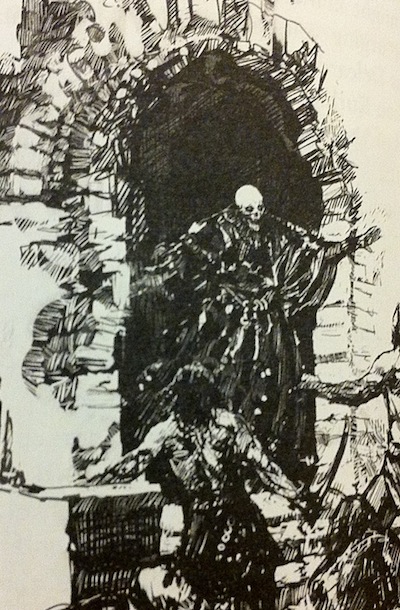
While reading the excellent Del Rey Kull collection, I came across this passage in the story The Cat and the Skull (page 114):

Kull tore the veil away with one motion and recoiled with a gasp. Delcardes screamed and her knees gave way; the councillors pressed backward, faces white and the guard released their grasp and shrank horror-struck away.
The face of the man was a bare white skull, in whose eye sockets flamed livid fire!

“Thulsa Doom!”
“Aye, I guessed as much!” exclaimed Ka-nu.
“Aye, Thulsa Doom, fools!” the voice echoed cavernously and hollowly. “The greatest of all wizards and your eternal foe, Kull of Atlantis. You have won this tilt but, beware, there shall be others.”

Totally Skeletor. The Del Rey edition is filled with art by Justin Sweet (like, one every few pages). Here is the one illustrating the scene above:

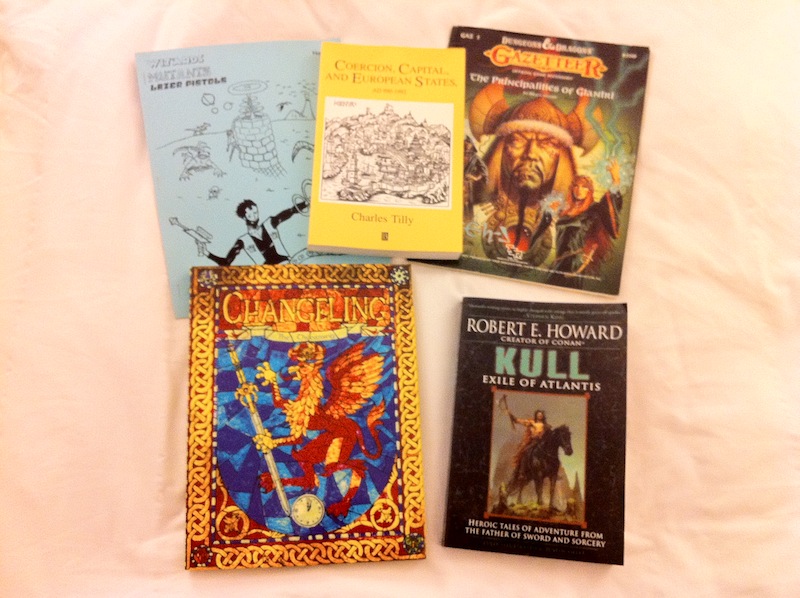
Somewhat related, these are the reading materials I took along for vacation reading (not including the three lifetimes worth of digital material I have on my tablet). Still reading Warhammer too, but I decided to leave that massive book at home.

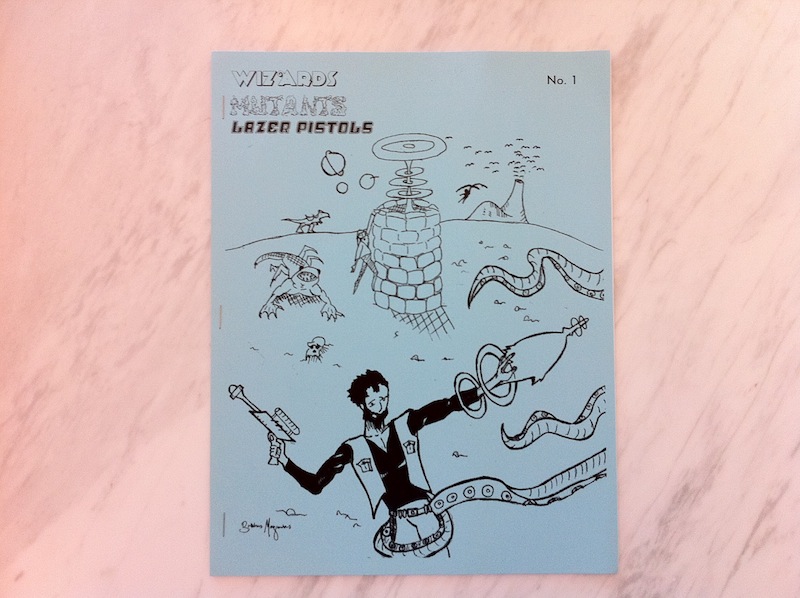
In case that picture is not clear, those are WMLP No. 1, Coercion, Capital, and European States: AD 990 – 1992, the old D&D Gazetteer GAZ3 The Principalities of Glantri, Changeling: The Dreaming (for some faerie inspiration), and the aforementioned Kull collection.

Chaotic Henchmen and WMLP

Some good stuff arrived earlier this week. Both of Guy Fullerton’s modules (F1 The Fane of Poisoned Prophecies and F3 Many Gates of the Gann) and the Wizards Mutants Laser Pistols zine. I have started reading F1, and am loving it so far. Both have sweet covers (by Mullen and Poag). The second in the series is not out yet, but is supposed to be at least partly set on the moon (as I understand it, they are related but not sequential).

I haven’t had time to more than page through the WMLP zine yet, but already I can tell that I am going to like the included dungeon. I was also hoping my copy of DCC RPG would arrive before I have to leave, but alas it was not to be. I ordered the gold foil one, and the pictures I have seen from others look amazing.

I’m going to be on vacation next week, so who knows how much blogging I will do. Probably much less or much more, I’m not sure which is more likely. So if I disappear for the next while, don’t worry, I’ll be back soon enough.

Mapping to the Battlemat

As you probably know, miniatures and a grid are generally assumed by Fourth Edition. They are not strictly speaking required for playing a 4E game (it is possible to run 4E combat entirely using imagination), but my players seem to like using the battle mat. Using miniatures is relatively new for me, as we never used minis back in the 90s when I played Second Edition. Everything was imagination and description, with the occasional sketch for clarification.

I currently use a Paizo GameMastery Flip-Mat. This is a dry-erase battle mat with dimensions of 24 x 30 inches. Now that I think about it, it seems like I would save myself some time if I used these same dimensions on my one page dungeons. I suppose this should be one of those self-evident things, but took me 9 months to realize (I my defense I’ve also been running lots of converted modules written for other systems). Defaulting to this size doesn’t restrict the overall size much, though it does place some constraints on individual rooms and encounter areas, as 5 foot squares results in 120 x 150 feet. This is really not that large of an area.

One danger of mapping to the mat is that players might figure out that maps tend to have these dimensions, and thus engage in metagame reasoning (“we should turn left here because that side of the mat is unexplored”). While I don’t consider metagame reasoning to be inherently bad, I do think it can take away from immersion in some cases, especially if it is happening during play (as opposed to deciding which feat to take or something like that). To combat this, one should periodically make partial battle mat maps. Keeping the overall dimensions in mind is still useful though, even in this case.

I have had two other ideas recently regarding handling the battle mat and miniatures in play. The first idea is to delegate the mat drawing duty to a player rather than doing it myself. I think this might speed things up and also increase player engagement. They would need to create the tactical map from my verbal description, though I could of course correct obvious inaccuracies. This also reminds me of how James from Grognardia has his players assist with creating models of dungeon areas while he is engaged in verbal description.

The second idea is switching to a gridless battle mat. I think there is good value in being able to see spacial relationships. What I’m less sold on is the numerical calculation that comes with counting movement squares and areas. I feel like this is the part of grid play that can potentially hurt immersion and game flow. It allows a sense of certainty that should not be present in a combat situation. For example, if you know the enemy has a move of 6 and you are 7 squares away. Now, one could always break the rules and vary NPC movement rates (or really anything) but I don’t like doing that. I’d rather have a bit of uncertainly built into the basic experience, and I think using a gridless mat might help with that (using common sense for things like movement distances and effect areas).

Morale, Cool, and Sanity

It struck me when reading Warhammer Fantasy Roleplay that the Cool stat really has a very similar role to morale in D&D. Description of cool (WFRP page 13):

This characteristic represents a creature’s ability to remain calm, collected – even sane – under severe psychological stress. Some of the creatures that inhabit the Old World are truly frightening, and may be confronted safely only by characters with a high Cl value. Cl is expressed as a percentage of 01-100%.

This stat is used when monsters can cause fear or terror. A failed check against fear basically means that a character may not take actions until they overcome the fear (one check possible per round, like a Fourth Edition saving throw). A failed check against terror sends the character to the fetal position for the rest of the encounter and grants an insanity point, which can lead to other bad things (like various types of madness). See pages 68 and 72 of WFRP for more details if you have access to the first edition.

Here is the morale text from Men & Magic (page 13):

Non-player characters and men-at-arms will have to make morale checks (using the above reaction table or “Chainmail”) whenever a highly dangerous or un-nerving situation arises. Poor morale will mean that those in question will not perform as expected.

One method to work a sanity system into D&D while cleaving to the traditional mechanics would be to start all PCs off with a morale of 12. This would represent naive young adventurers brimming with confidence and perhaps in some cases an iron will. Every time a character witnesses a sanity-threatening event (this would be campaign dependent, but could include encounters with undead, certain kinds of black magic, watching a companion die, etc) a fear saving throw would be required (probably a save versus spells). Failure would indicate loosing a point of morale, and open up the possibility of failing a morale check. I like this idea because it doesn’t require any new rules.

There have been several other recent D&D approaches to sanity. In Barrowmaze there is an optional fear rule where PCs accumulate points when they encounter undead and go insane when their total equals or exceeds their wisdom score. These points can be removed by spending time in civilization. Akrasia also has a wisdom-based sanity system. If you haven’t read his Swords & Sorcery house rules, get to it. It’s one of the best free OSR supplements out there (a free PDF is available). The free TOTGAD Compendium (now available in hard copy too) has terror, horror, and madness rules. The TOTGAD systems also rely on saving throws and have tables of possible outcomes for failed saves. I recently used his madness table for Death Frost Doom and it worked very nicely.

Halfling Magic-Users

The original hobbit race in OD&D (if limited to the rules from the 3 LBBs) is objectively less powerful and has less potential (in terms of game mechanics) than other races. Hobbits can only be fighting-men and are limited to fourth level. Their only benefits were: “magic-resistance equal to dwarves (add four levels for saving throws), and they will have deadly accuracy with missiles as detailed in CHAINMAIL” (Men & Magic page 8).

What I have gathered from reading various bits online is that Gary likely added hobbits for players who wished to emulate Tolkien (though please take this as hearsay). Having hobbits be weaker actually fit the source material (hobbits as humble if diligent creatures), and there was no particular desire to balance classes back then (especially since parties would often be of mixed level anyways). Thus, one can think of playing a hobbit as “hard mode” D&D.

Bilbo was described as a burglar, but he was nothing like the inspirations for the original thief class (the Gray Mouser or Cugel). Frodo even less so. Despite that, in Supplement I: Greyhawk, Hobbits were allowed unlimited progression in the thief class. From there, the thief evolved into the ninja-like rogue class and the halfling race (due to several mechanical benefits) was often considered the best choice for a rogue. The PC in my current 4E hack game that consistently does the most damage is a halfling rogue.

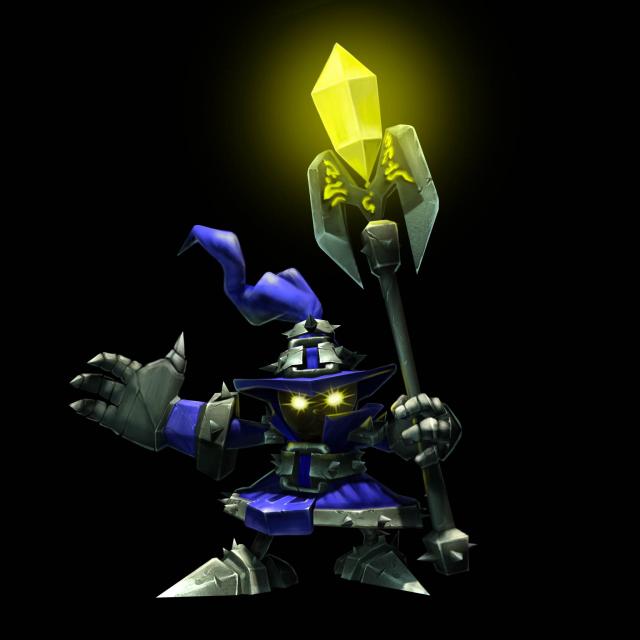
Now, I love ninjas as much as the next guy, but that archetype is not generally what I associate with halflings. For another take, Final Fantasy did the “cute little guy” in a way would also work pretty well as a tabletop RPG character: the black mage. I know halflings are described as not making very good wizards in most settings, but maybe this would be an interesting fact to change (or allow PCs to play against type). It does seem like magic might be a natural fit for an ambitious halfling that wanted to make it in a world full of tall people.

Veigar: “I am evil, stop laughing!”


Final Fantasy Black Mage

Orco from He-Man

Vivi from Final Fantasy 9
Veigar from League of Legends