
Not dated. Probably from around 1996.

Not dated. Probably from around 1996.
I also roll my eyes whenever anybody talks about “pure OD&D.”
OD&D was about as pure as a backalley sleeper. It doesn’t borrow from other genres, it follows other genres into alleys and mugs them and goes through their pockets for loose ideas.
— Michael Mornard, on the OD&D Discussion forums
Here is a method for randomly determining starting equipment by class. This is intended for B/X type D&D (or similar games) and the tables have been engineered so that they work no matter the class.
Cowards may, of course, choose rather than roll.
dH = hit die (e.g., fighter dH = d8, magic-user dH = d4)
Weapons
Roll 2dH twice for beginning weapons; re-roll duplicates if desired.
Armor
Roll dH for beginning armor.
Equipment
Roll d20 four times; re-roll duplicates if desired.
Each PC begins play with:
Using 2dH to select weapons creates a probability curve.
The most common weapons by dH:
It is only possible for classes with dH = d8 to begin with the heaviest military weapons, or to begin with any bulky weapons.
Armor possibilities by dH:
Also note that in many systems, 10 minus (armor dH roll) = AC. Though not important, this is a pleasant symmetry.
Any character may try to pick locks using a set of lock picks. Non-thieves have a flat 1 in 6 chance, adjusted by dexterity. That is, a character with extraordinary dexterity (13 or higher) has a 2 in 6 chance.
I should have included this in my weapon damage by hit die post, but I didn’t think of it then. Check out this simple table of correspondences:
That is, characters playing to type in B/X D&D naturally do hit die damage. The relationship breaks down slightly when ranged weapons are considered. Long bows inflict d8 damage and slings inflict d4 damage, fitting the pattern, but what ranged weapons do clerics use? If it’s a crossbow with a wooden stake, we are in business. In any case, the point here is not that this is an iron-clad rule, merely that it is a tendency.
The thief/rogue actually fits this pattern relatively well too, with dagger/short sword, and d4/d6, respectively. This also reflects the change from the thief (sneaky, bad at combat) to the rogue (stealthy, striker).
The main benefit of damage by hit die is to reduce a rather complicated table reference (the weapon damage chart) to an easily memorable rule. This is similar to what Talysman is trying to do (*) with his Liber Zero clone project. Note that this is not a core mechanic, which may have only one kind of resolution mechanism, but may also have a huge number of very specific rules for modifying the target number based on circumstances. Easily memorable elements may use several different resolution mechanisms, but they must not rely on a large corpus of external rules to function.
(*) – In his own words:
one of my personal goals with Liber Zero (quickly becoming the central goal of LZ) is to strip the game down to easily-memorizable elements so that the game can be played without reference to books
See here for more details.
At first I thought that I would have nothing to add to the deluge of reactions to the fifth edition announcement. On reflection, I do have a few things to say.
Here is a super-simple class inspired by the Carcosa psionics system.
Each level, roll for (or select, you cheater) a new psionic talent (re-roll dups):
More thoughts on the entirety of the new Carcosa book coming soon.
HD 3-18+, AC as plate, 3 attacks or breath, move 90′, fly 240′, morale 9, # 1
A dragon’s age and power are reflected by hit dice. To determine dragon hit dice randomly, roll 3d6. If the result is all sixes, roll another d6, adding the result to the previous total. Continue this procedure as long as sixes are rolled.
Hit dice also determines the damage inflicted by a dragon’s fiery breath. For example, a 12 hit die dragon will do 12 dice of damage to all in the area of effect (half damage if a save is made). Once a dragon has breathed fire, they must wait 1-3 rounds before they can breath again. Breath weapon damage dice, like standard hit dice, are always d8s. The breath weapon range is equal to the number of hit dice multiplied by 10 feet, and it spreads out like a cone (the dragon has approximate control over the cone width).
Dragons may either breath fire or make up to three physical attacks (these could be bites, claws, tail slams, or any other kind of attack that makes sense in the situation at hand). Each physical attack does one die of damage. The die used should be that closest to the total number of hit dice the dragon possesses. For example, an 8 hit die dragon does d8 damage per hit. A 9 hit die dragon would do either d8 or d10 damage per hit (decide beforehand, determine randomly, or alternate).
Dragons are huge, scaled, lizard-like, fire-breathing monsters of great cunning, greed, and intelligence. Their intelligence, however, is of an alien sort. Being almost entirely self-sufficient, they have little use for society or technology, and are unable to relate (other than superficially) with lesser beings regarding these matters. They seek only treasure, ever growing domain, and occasionally worship. Unlike most creatures, age only adds to a dragon’s power. Surviving wyrmlings become ever more dangerous.
The youngest dragons are pony-sized, and generally grow until they reach the size of an elephant in body (though their length from nose to tail and wing span will be much greater). Though there seems to be no absolute limit on dragon size, the rate of their growth does slow significantly once they have reached that size. In color, their scales are inky black, earthy brown, mouldy green, rocky gray, or bloody crimson (or some combination thereof). Dragons enjoy eating any kind of meat, particularly living meat, though they do not require it for sustenance. A dragon deprived of meat for too long, however, will become surly.
Dragon reproduction is mysterious. They are thought to hatch from eggs, but have never been found in mated pairs and will rarely cooperate. They are by nature agents of chaos, and logic suggests that they would burn themselves out over time. However, this has not happened.
A dragon can be subdued by nonlethal damage. A subdued dragon will turn on their master if they perceive weakness, but will otherwise continue to serve as long as they are fed well and rewarded with treasure (a good rule of thumb would be about half of treasure accumulated). Dragons will also generally challenge their master when they have grown into another hit die, but this will sometimes take longer than their master’s lifespan. Such dragon lords often become petty tyrants, though their rule rarely lasts long due to the inherent instability of the relationship.
 |
| Source: Ljubljana Dragon |
I think that in later versions of D&D, dragons have come to be somewhat deified. I don’t like this. I think that dragons should be fearsome and terrifying, but I don’t think you should need to be a demigod to challenge one. A young dragon should be something that could be run down by a fourth level fighter with a lance (given some luck), or even found on the first level of a dungeon.
In terms of style, there is a tension between the monstrous dragon and the sleek panther-like dragon. The sleek dragon has come to dominate fantasy art. The monstrous dragon tends to look more like it came from a fairy tale, and is often (though not always) fat. For examples, see the Holmes basic set dragon, the Rankin/Bass Smaug, the animated Flight of Dragons movie, or almost any painting of St. George and the dragon. For examples of the sleek dragon, see current D&D dragons and the work of Jeff Easley. I am interested in portraying a more mythic dragon, though still influenced by Tolkien’s Smaug. None of the gimmicky multicolored D&D chromatic dragons. My dragons all breath fire.
Regarding behavior, I want to emphasize that dragons do not live by the same rules as mortal races. I picture dragons as intelligent, but alien and prone to underestimating others.
Incidentally, I didn’t stick that bit in their about dragons not needing food for sustenance with any particular goal in mind; it just felt right given their embodiment of ever-growing power and danger. This, in concert with the growth of dragons due to increasing hit dice, might however explain why dragons sometimes get stuck underground. I’m not going to look that gift horse in the mouth. Maybe they even originate in the underworld and must reach the surface before they grow too big. Or maybe, like adventurers, they go underground in search of treasure, but sometimes outgrow their entrance.
In OD&D, total hit dice varied by dragon type, but age (and hit points per die) were determined by one d6 roll (1 being very young, 6 being very old). A similar procedure is used by the original Monster Manual, though a d8 is used instead. This is interesting, but odd. It means that given a 10 hit die dragon, there only exist dragons with hit point totals in a multiple of 10. I like the identification of age with hit dice, but rather than vary the HP per hit die (is that done with any other monster?), why not vary the number of hit dice for age? This also scales the attack bonus, which makes sense to me.
Traditionally, in both OD&D and B/X, breath weapon damage is non-random. It does automatic damage equal to the dragon’s remaining HP. I changed this because I like uncertainty, I like to roll dice, and I don’t like to expose monster health meters.
The rules for dragons take up an inordinate amount of space in pretty much all the editions I have looked at. Despite that, I still feel like my draft is a bit too wordy. Three paragraphs of rules and four of flavor. Any tips or suggestions are welcome (as always).
I have always considered naming things to be a hard and important task in tabletop RPGs, on both sides of the screen. Much of the flavor of a game setting is communicated via the names, especially for homebrew settings that don’t have extensive canonical literature with illustrations. Probably the largest effect of gaming on the non-gaming parts of my life has been the constant mining of everything I encounter for names. Novels, street signs, captcha forms, anything. Even when I was not actively gaming, I still kept lists of names. Dada’s little baby namer has also been a frequently used resource.
If you had any doubt about the power of naming in the real world, you need to look no further than our own little echo chamber. Giving concepts like sandbox, megadungeon, agency, railroading, and tent-pole easily remembered names gives them power. Half of software engineering is probably built around managing complexity through abstraction and naming.
The power of the true name can also be the basis of magic in folklore and fantasy. Le Guin’s A Wizard of Earthsea is probably the most influential source of this trope in mainstream fantasy, but it also shows up in Cook’s The Black Company and Rothfuss’ recent The Name of the Wind.
Good naming for tabletop RPGs follows different principles from other media, mostly because the names are often communicated verbally rather than visually. Names that are too complicated will probably not stick. Also, players tend to have notoriously short attention spans for setting detail. One solution to this that can work with some groups is to allow players to name some things as they come into contact with them or if they are connected in some way with a PC’s background.
I just finished reading The Black Company, and I have to say I am quite taken with the simple naming style. Names include Croaker, Silent, Goblin, One-eye, and Elmo. I think this style would work wonderfully for D&D; it doesn’t take itself too seriously (if you try to make something sound self-consciously serious, I guarantee some other player will satirize it), and such names are easy to remember.
Despite all this, the name of one of my longest-played characters (an elf wizard in second edition) was lifted whole-cloth from one of R. A. Salvatore’s lesser-known non-D&D books (The Woods Out Back): Kelsenellenelvial Gil’Ravadry, or Kelsey for short. In my defence, I can only say that at least I didn’t name him Drizzt.
Magic item: Nomenmancer’s Wand
(2d4 charges)
The nomenmancer’s wand is a slender rod several hands long crafted of an unknown metal. If examined closely, it is clear that the wand’s form is like that of very elongated tetrahedron (a four-sided solid with triangular faces, one of which is the base). Tiny runes, symbols and characters cover the three long sides, fading into nothingness as they approach the tip.
The wand stores true names.
The wielder of the wand gains a +10 bonus to saving throws versus spells cast by any specific entities whose names are so stored.
The wand may also be used as a stylus to prepare a scroll of command. Such a scroll functions as the charm person spell, but only for the entity in question. No saving throw is allowed initially, though saves may be attempted later (based on intelligence) as per the charm person spell description. Creating such a scroll discharges the name. Command scrolls may be used by any class, much like protection scrolls.
Any entity that becomes aware their name is stored in a nomenmancer’s wand will stop at nothing to recover it.
Methods for recharging the wand have been lost to the mists of time.
| Revisitation: a series of posts that each feature a quote from a classic source along with a short discussion. Quotes that make me question some previous assumption I had about the game or that seem to lead to otherwise unexpected consequences will be preferred. |
This quote comes from the monster entry for the common mule in Moldvay Basic (page B39):
If the DM permits it, mules can be taken into dungeons. A mule can carry a normal load of 2000 coins (or 4000 coins at most, with its move reduced to 60’/turn).
That’s 200-400 extra pounds of equipment or treasure.
Some other benefits:
I would say that mules compare favorably to hired porters.
Unlike most other game components, mules are primarily about encumbrance. Their function is to carry things. If you are not using encumbrance rules, don’t be surprised if your players ignore mules. I have never been satisfied with the old coin-based encumbrance system, or more “realistic” systems that sum weight carried (realistic is in scare quotes because such sums don’t take into consideration awkward items or how the weight is distributed, which is just as, if not more, important than the absolute quantity carried). Luckily, the LotFP encumbrance system (free Rules & Magic book, pages 38-40) covers mounts and pack animals as well, though there is no dedicated encumbrance record sheet for animals yet (something I hope to rectify soon — it’s on my list of things to do).
Dragon #48 (“Carrying a heavy load? Let a mule do it for You!”) suggests that mule training should require time and resources:
Players can train mules in uninhabited caves and ruined fortifications, offending their sensibilities until the animals are used to odd smells, dank dungeons, and strange noises. All of this takes time — up to several months if you want a really good mule — but the players can hire someone else to do the job so that they remain free to go adventuring while the mule is being trained.
The article goes on to say that a druid could do this through magic more quickly. As long as an adventuring party is not asking their mule to do anything ridiculous, I don’t think I would require special training.
If that’s not enough, you can go read the 121 post (at the time of this writing) Dragonsfoot thread on mules, from which some of these observations were drawn.
 |
| Image from Wikipedia |
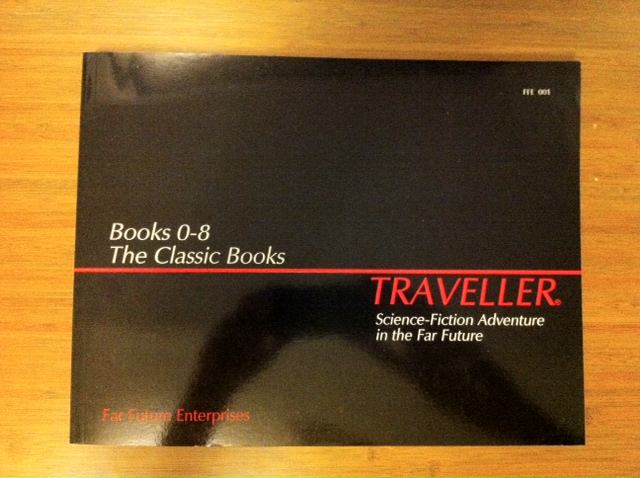

I’m more of a fantasy person than a sci-fi person, and I didn’t even know about Traveller until some time in 2011. But references to it kept popping up on the blogs and forums I frequent, so I knew I needed to check it out at some point. At first I was going to pick up a set of the original Traveller 3 LBBs (little black books) from the old boxed set; unlike OD&D, the price for an original set is not that high. Then I found that classic traveller was recently reprinted as a collection, Books 0-8, at a very reasonable price. As you can see from the picture, the book is printed in landscape rather than portrait (I think it might be a literal reprinting of the digest originals).
I got interested in Traveller because it seems to embody its own little niche in RPG system design. From where I’m sitting, there are three three main paradigms in tabletop RPGs:
GURPS is also skill based, no? GURPS is older than WoD, so I should probably list that as the exemplar of skill based RPGs, but I’ve not played it myself. Maybe new-fangled story games are a fourth paradigm (games that have mechanics built around narrative control), but I’m really not familiar enough with them to say. Am I missing anything important? Would anybody draw the category lines differently?
The influence of the life-path leg seems to be rising in the OSR. Just days after ordering Books 0-8, I came across the announcement of a development forum for Shot & Sorcery, a LotFP take on historical weird fantasy heavily inspired by Traveller. And James Maliszewski released Thousand Suns in December (it has some relation to Traveller, right?). Joseph Browning (of Sorcery & Super Science) is working on Worlds Apart: A Fantasy Role-Playing Game of Exploration and Trade (which is perhaps nearing release).
Some other relevant, though older, links:
I have this lingering idea of equivalency between levels 1 through 14 in D&D (the range in B/X) and the character generation procedure in Traveller. That would give a new meaning to the idea that “character background is what happens during play”. And the main body of a Traveller game would be roughly equivalent to domain and stronghold play in D&D.
It seems like level 15+ D&D could go in one of two directions: this kind of domain play or demigods/immortals (see this post from Zak and skip to the paragraph about Thor).

