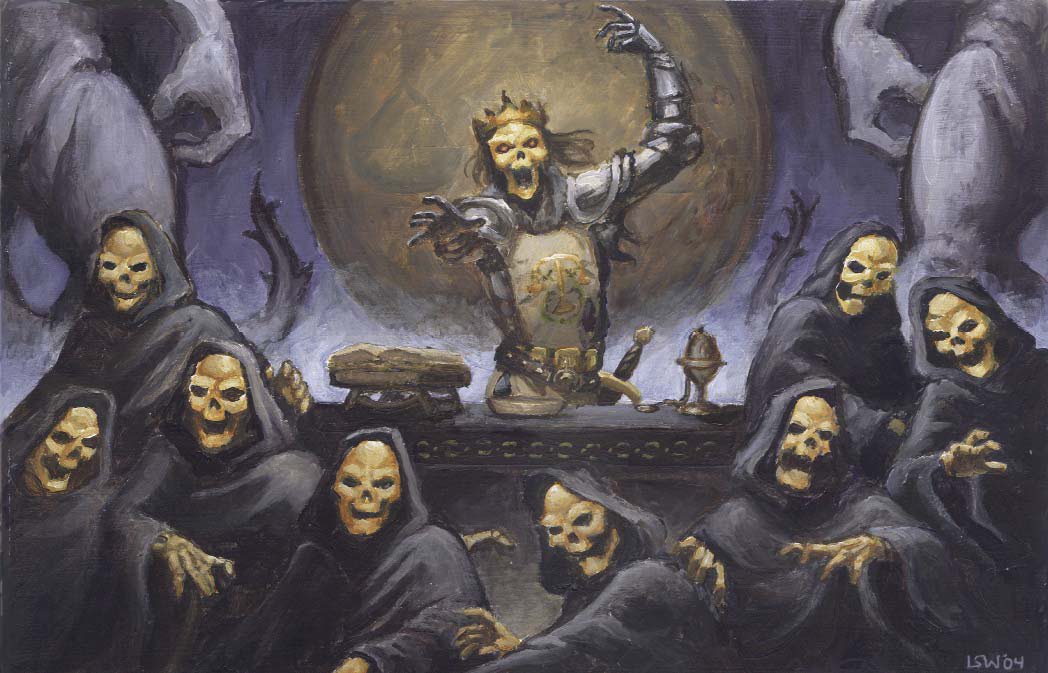
This is from the article by Lee Gold in Fight On! 6 (page 111, “World Creating as a Hobby”). 3d6 for each of the 7 virtues & sins.
| Virtues | Sins |
|---|---|
|
|

This is from the article by Lee Gold in Fight On! 6 (page 111, “World Creating as a Hobby”). 3d6 for each of the 7 virtues & sins.
| Virtues | Sins |
|---|---|
|
|
This fourth edition scenario is very much in the hexcrawl/megadungeon tradition. It consists of a number of sites spread around a valley that can be visited in any order the players desire, and the locations have varying levels of difficulty.
Long ago, a dark power traveled through the space between worlds, intent on finding world upon which to wreak havoc. After seeding countless wars on many worlds, it found a new world to ruin. There it crash-landed, embedding itself deep in the ground and carving a valley-sized furrow in its wake. Patient beyond mortal comprehension, it began to sow the seeds of evil and reach out to those of a perverse and corruptible bent.
The Chaos Scar is a long, wide valley carved long ago by the fall of a massive meteor. As the giant rock passed overhead, milk curdled, livestock fell over dead, and ill fortune befell all. The meteor crashed into the earth with deafening force, and red radiance lit the sky for a week. Then it vanished.
…
The Chaos Scar itself is death to most who wander in. It is filled with evil and riddled with caves both natural and tunneled by generations of monstrous denizens. The deeper one travels into the valley, the deadlier the foes lurking in its caves and hollows. Strange features have been raised, or have simply appeared, within the Scar—circles of standing stones, bizarre towers, grotesque cottages, and other more otherworldly features. Capping off the valley is the fortress of Hallowgaunt, home to the mysterious Brotherhood of the Scar, crowned by a perpetual storm of black clouds and crackling lightning.
Okay, ignore that last bit about the perpetual storm of black clouds and crackling lightning. The rest of that description is pretty evocative, and though it is aboveground, it fits the classic megadungeon structurally. It still has a bit more linearity than most people interested in sandbox play would probably want, but that is relatively easy to adjust.
There is no overarching campaign goal other than to reach the end of the valley and destroy the meteor. … Finally, feel free to allow the PCs to chart their own course. One of the goals of this campaign is to reduce the workload of DMs running it. Once the valley has been populated by a few caves, PCs should be allowed free reign to choose which dungeon they approach next.
Most of the content is behind the D&D Insider paywall. I was briefly a member a few months ago so that I could see what was on offer. Most of the locations within the valley are not that special though, and are of the form “monster X has been drawn by the power of the evil relic to the valley and has taken over abandoned structure Y”; it’s easy enough to make such areas up yourself, or drop modules in. The published ones also tend to be rather small, and the encounters are not usable directly for editions other than 4E.
I like campaigns where magic items are special. So, assuming that magic items are not a dime a dozen, why not take the effects of enchanted items to their logical conclusion, and see what result that has on the setting? I was inspired by this passage in the Vornheim City Kit, about the medusa Eshrigel:
Once, demons ruled every universe, unchecked. Then came 12 sisters – medusae – they looked upon the demon kings and changed them to stone, and drove the rest away. The grey bones of this earth were hewn from the petrified bodies of these demon kings. Or at least that’s what the 12 sisters will tell you.…If Eshrigel is slain, all the statues will come to life. Their details are left to the GM. If the myths are true, about 1/12 of the stone on the planet (and 1/12th of the planet itself) should revert to flesh upon her death.
My first take was to riff directly on this idea. The wilds are peopled with fantastic statues of beasts, giants, and warriors. The statues are ancient, but still have incredible detail. Sages dispute the origin of these statues. Some claim that they were the work of skilled ancient stonesmiths. Others claim that they were the results of ancient wizardry, but still merely decorative work. Some demon hunters claim that the current plague of horrors did not always roam the wilds, and that in past ages when demons directly entered the world they would be turned to stone, forcing them to work from the shadows and control people by possession; this was ended when a reckless warlock figured out how demons could enter the world without being turned to stone and traded the knowledge away.
The truth is that an ancient magic-user ended a great chapter of the demon wars with a powerful wand of petrification. If the wand is ever broken, all creatures that were petrified by it will return to life. (Or perhaps it was a collection of 7 wands, wielded by a secret society of magic-users?) What silly adventurer will break the wand to free a petrified companion, and inadvertently unleash an ancient cosmic war?
I am sure that there are many other magic items that are usually treated with little fanfare, but which could have very interesting setting ramifications. Assuming that these items are essentially artifacts, and not something that can be manufactured, we don’t have the problem of magic-as-technology. I’m certainly not advocating any sort of naturalism. More like investigating what unintended consequences might come from some of those magic items. For example, Plato’s Ring of Gyges is, in D&D terms, just a ring of invisibility. And the sorcerer Thoth-Amon in Robert Howard’s stories derives his magic seemingly entirely from The Serpent Ring of Set, as when he looses the ring he has no power to resist becoming enslaved.
As I don’t pretend to impartiality, I’ll go ahead and say that my favorites are probably Fight On! and Knockspell, in terms of content that I find immediately useful.
(This list has grown to the point that it probably deserves better organization or subcategorization.)
Active:
Inactive:
Completeness is not a quality that I aspire to in this post, as I want this to be an edited collection of resources I find useful. That being said, if you notice that I am egregiously ignoring something, please let me know so that I can investigate it. I don’t want to end up with a laundry list, however. Also, I know that this collection is biased towards the present. But then, isn’t everything? It is, after all, where we always live.
So, I was thinking of doing a series on the “changing face” of various common aspects of the game, comparing how different versions do the same thing. For example, initiative. But it turns out someone else has just already done such a post, and they did it really well. This is a good thing! Less work for me to do. Monsters & Manuals also discusses.
The original motivation was to familiarize myself with how earlier versions of the game did things, as when I played before, I mostly used a heavily house-ruled version of 2nd Edition. There are still probably many other fruitful topics for such a series; if I can accomplish the whole project by merely redirecting myself to content elsewhere on the Internet, all the better.
Folkloric, mythical goblins are much more interesting than the “monster ecology” goblinkind that is standard in D&D. I think there is a lot to be gained from trying to access some aspect of the “bogeyman” tradition that originally led to the goblin, rather than the “evil stormtrooper” depiction that has become more common. However, when using goblins, there are a whole set of player assumptions that you have to deal with. If you say “you see 5 goblins”, that will produce a certain quantity of unavoidable meanings in your players’ heads that you probably wish were not there. The first step, I think, is to not mark them as goblins initially, and only later allow the players to identify them. But that still begs the question, what are a more fantastic form of goblinkind that would still work in the context of the game? I don’t think it works to say that they are “really scary” and leave it at that.
Well, who started this modern fantasy trope to begin with? Let’s go back to Tolkien and see what his example actually says, rather than the examples of his imitators. From Wikipedia, on Tolkien’s goblins:
In an essay on Elven languages, written in 1954, Tolkien gives meaning of “orc” as “evil spirit or bogey” and goes on to state that the origin of the Old English word is the Latin name Orcus — god of the underworld.
The article goes on to list 7 possible origins for goblinkind:
As is often the case, the banal cliches that have come down to us from the followers of Tolkien are not much connected to the actual ideas behind Middle-earth. None of these examples are close to “just some other race that evolved (or was created by a rival god) and came to be opposed to the PC races”. They all focus on the idea of falling from grace, or corruption.
So let’s say that a goblin is a human that has been corrupted by arcane forces, perhaps to be the slave of some wicked magic-user, or demon. Having a savage, id-like, but still clever, servant would be more than a little useful to such a patron. In addition to creation through dark rituals, perhaps there are locations that are sources of arcane pollution which cause nearby residents to slowly become goblins.
Note that this conception does not preclude a dark lord like Sauron from actually raising a horde of goblins, but it does ensure that they are not “just another race”.
And what happens when the corruptor dies before the goblin? Does the goblin slowly revert to his past self? Or does the goblin start to regain his past mind, but remain corrupted in body?
It is also possible that this would still allow for the use of goblins as a PC race to replace halflings, though it would have to be handled carefully to preserve the desired style.
So I don’t think it is entirely unwarranted to begin discussion about the necromancer in 2E. The 2E Necromancer requirements are (from Table 22: WIZARD SPECIALIST REQUIREMENTS in the 2E PHB): human, 16 wisdom, opposed to the illusion and enchantment/charm schools.
2E spells in the Necromancy school: cantrip (1st), chill touch (1st), detect undead (1st), spectral hand (2nd), feign death (3rd), hold undead (3rd), vampiric touch (3rd), contagion (4th), enervation (4th), animate dead (5th), magic jar (5th), summon shadow (5th), death spell (6th), reincarnation (6th), control undead (7th), finger of death (7th), clone (8th), energy drain (9th).
That’s not very many.
Also sprach Jeff Rients:
Personally I loathe all the canonical cheating methods. I think there are two and exactly two legit ways to generate scores for D&D characters:
1) 3d6 in order
2) write down whatever numbers you likeAnybody stuck on “wants to play a X” should be using the second method. I’ve used this method before. One guy wrote down all 18’s, including 18/00 Str. Somehow, we all survived the experience.
A few days ago, Matthew Finch (of Swords & Wizardry) released the Tome of Adventure Design (TOAD; awesome acronym). Of course I bought a copy right away, but I haven’t had a chance to peruse it in detail yet. However, one passage did jump out at me immediately:
I should say up front that these are tables for deep design – in other words, most of them are too long, and contain too many unusual or contradictory entries, for use on the spot at the gaming table. There are already many excellent books of tables for use on the fly; the tables in these books are different. They work best as a tool for preparation beforehand, providing relatively vast creative resources for browsing and gathering, rather than quick-use tables designed to provide broad, fast brushstrokes.
It seems to me that randomness has two direct key functions in old school gaming:
The first function, when properly employed, also helps create situations which can surprise the referee in addition to the players. This is such a common aspect of table-top RPGs that I don’t think it needs any more discussion.
The second function is newer to me, and also seems to be one of the core OSR referee techniques. I remember playing around with the random dungeon generator in the Gygax DMG, though I’m not sure if it led to any substantive adventure locations. I had the sense, and I think many people still have the sense, that “good” design comes directly from a planner, and that using tables would be somehow cheating. Using tables to design your masterpiece setting would be akin to Dostoevsky using dice and tables to determine the plot of Crime & Punishment (also related: frustrated fantasy novelist syndrome).
This seems to be an almost Hegelian process of thesis, antithesis, and synthesis, where the thesis and antithesis are random results which at first glance seem contradictory. The reconciliation of this incompatibility is what prompts the creativity.
There are several other good products that I have come across that are based on similar principles:
Talysman writes about classes as answers to the question “how do you solve problems?” (the discussion at Grognardling is also worth reading, and is what originally pointed me to Talysman’s post).
I would reiterate this as:
I see this working as follows: