Restless Dead

Undead come in two varieties: sentient and mindless. This reflects the philosophical doctrine of mind/body dualism, and suggests that many undead may be incomplete beings. A ghost, for example, is a spirit or mind without a body. A zombie is brute flesh with animating will but no mind or soul.

What happens to the spirit when the body is called back to service in the case of the mindless undead? Does the campaign world have an afterlife or an underworld where the spirit resides? Is the spirit gladdened by the body’s return to service? What if every time a skeleton or zombie is animated, the ghost is also pulled back to the mortal realm, with no chance for eternal rest until the zombie is destroyed? Ghosts could be great allies to player characters.

Perhaps necromancy requires that the ghost be imprisoned, preventing it from reuniting with the body, resulting in necromancers collecting such trapped spirits (which would also be of interest to demons or other entities that might value such things). This would result in necromancers making many ghostly enemies, and might contribute to their terror of death and their own search for immortality and lichdom. Failing that, they would seek to escape the grasp of the underworld by true extinction of the soul. A sort of necromantic nirvana.

These trapped spirits could also be bound to objects. Maybe some or all magic items are the byproduct of such necromancy. FrDave had a post about a magic sword that was infused with the spirit of an elf-maid, and in D&D magic swords are traditionally sentient; this is another way to explain where magic swords get their sentience.

The most terrible form of zombie creation: tearing the soul out of a still living person, leaving only an undying and mindless slave.

Blackwater Falls System

My first post to this blog was about a campaign that was called Blackwater Falls. As I mentioned there, the game started using D&D rules, but was then transitioned to a custom system that we designed. I have come now to appreciate basic-style D&D rules much more, and I don’t think I would want to play again using this custom system, but I think it is interesting enough to sketch out what we came up with, at least the parts that I remember.

The basic design was inspired by the White Wolf system of combining attributes and abilities for task resolution. We really liked the idea that a character’s inherent makeup and training would combine to give a probability of success (really, this is a systematization of the idea of nature and nurture). What we didn’t like was the complicated multi-die plus target difficulty mechanic that White Wolf used. We wanted to be able to adjudicate things with a single die roll, like an attack roll in D&D.

Each attribute, skill, or power was rated from 1 to 10. In the case of attributes (like strength), 5 was average, 1 was incompetent, and 10 was world-class. In the case of a power or skill, 1 meant superficially trained or limited power and 10 meant mastery.

Any particular task resolution would be handled by combining an attribute with a skill or power. This is almost directly from White Wolf, which would have combinations like Strength + Brawl, Dexterity + Dodge, and Intelligence + Linguistics. In that system though, each score is rated from 0 to 5, and each point adds another d10 to your dice pool. Our system would yield a number between 1 and 20. This number would then be adjusted for situational difficulty, down for something hard, and up for something easy. Then we would try to roll less than or equal to it on a d20, like a D&D ability check.

I don’t remember every attribute we used, but I know they included Strength, Agility, Stamina, Intelligence, and Appearance. We used a linear point-buy system, and, like in White Wolf, new points in attributes and skills could be purchased with experience.

The skills selection was free-form. If you wanted your wizard to be able to cast a spell like burning hands or fireball, you would make up an appropriate skill or power that was not too general and take points in it. For burning hands, the power might be pyromancy. The power value would thus both determine what you were capable of (a single point might allow lighting a candle, or manipulating a natural fire, while a fireball might require 4 or 5 points). The referee would be required to rule on whether a particular effect was consistent with a skill value. A number of common permissible effects were quickly accumulated through use (similar to the precedent in law of past cases), but we never felt the need to codify or write down what particular skills could do, which left significant room for creativity. Special racial or supernatural abilities were also represented as skills and had to be purchased with points in the same way. One example of this was a character of mine that could switch heads (yes, you read that correctly). His name was Clair de Lune and he had a collection of heads in special glass cases and a magic scarf that he used to connect them to his body; this was related to some curse in his background story and mechanically he had some sort of skill which allowed him to harvest body parts from others. Most of our characters were not that odd, but the system seemed to support such concepts.

A health score was derived directly from stamina, though I don’t remember how. Full health might have just been equal to stamina. I have no memory of how we handled armor. I think it both made characters harder to hit and absorbed some of the damage points, in the process decreasing its own pool of structural points (or something like that).

I believe we called this system Puppeteer. Unfortunately, I seem to have lost all hard documentation.

Titles as Achievements

One relic of the older editions are level titles. They started out as wargaming shorthand (as in, a hero is worth 4 fighting men). As video games have show, even otherwise meaningless achievements are psychologically very powerful. Rather than just hand out titles mechanically with level progression, why not make characters earn them literally?

Sample titles: champion, conjurer, veteran, journeyman, robber, baptist, demoncaller, etc. In addition, any organization within the campaign world can have a series of ranks or titles. Such a collection of titles is also a list of adventure seeds that suggests profitable courses of action to the players without compelling them to do anything.

There is no reason why a title could not also be accompanied by an XP award, optionally. It is often suggested that it would make more sense, for example, for a magic-user to gain experience from casting spells. Rewarding experience for titles gained seems like a reasonable way to go about giving experience for activities without overly changing the underlying incentive structure. And it reflects the fact that the first time you do something is special. You can get experience for killing more than one dragon, but you can only ever get the dragonslayer title once.

Don’t forget how Bilbo described himself to Smaug: clue-finder, web-cutter, stinging Fly, ringwinner, luckwearer, barrel-rider.

Maybe I’m being unnecessarily naturalistic, but doesn’t it also make more sense to refer to Felonius as a seer after he has successfully scried something?

Thief Magic

Despite the fact that I am very partial to the LotFP specialist interpretation of the thief archetype, I just had another idea for how to do thieves after reading Matthew James Stanham’s excellent article on thieving abilities. He writes:

Moreover, and as Robert Fisher pointed out to me several years ago by ways of his writings on the subject, thief abilities are not just colourfully named skills, but frequently duplicate spell effects, such as silence, invisibility, knock, find traps, and spider climb. [Link to Robert Fisher’s page updated so that it works.]

Why not just give thieves the ability to cast those spells? They could get one every other level, or perhaps every level, either in a fixed order, or based on player choice. It would probably be better to create a fixed order, both to decrease character creation load and because invisibility at first level might be too powerful (on the other hand, is invisibility really more powerful than charm person or sleep?). Each spell could be used once per day, or maybe the total number of spells per day equal to level or level divided by 2. If you wanted to expand the list of thief spells, other candidates might include some of the illusionist spells and animal friendship (I’m thinking here of Alec from the Nightrunner series, and how he was able to pacify guard dogs by saying “peace, friend hound” in Elvish or something like that).

These abilities could either be conceptualized as an inherent ability to tap into magical power (this would result in a more supernatural thief class) or something closer to the spells of a hedge wizard, which would require the thief to keep a spell book and memorize spells in the same manner as the standard magic-user class. Idea: thief that tattoos his spell book all over his forearms. Further idea: magic-users consider thieves’ guilds to have stolen their secrets, and seek to punish magic-using thieves whenever they get the chance.

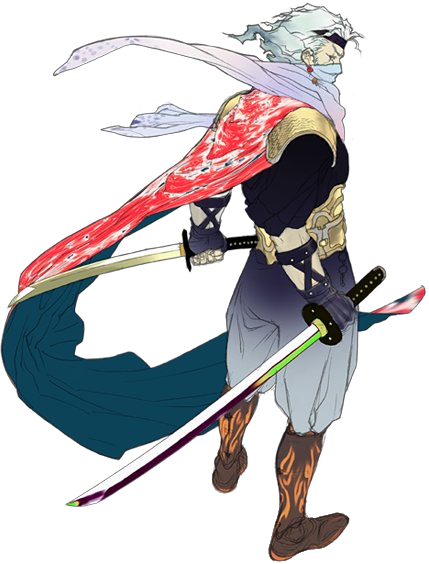
There is significant precedence for this approach, both in terms of rules for other classes and in terms of the inspirational literature. The paladin, for example, has the ability to cure disease, as the spell. Thieves gain the ability to cast spells from scrolls. And The Gray Mouser was a wizard’s apprentice before he was an adventuring rogue. Edge from Final Fantasy IV (great picture here), who was able to use ninja magic, also comes to mind.

Underground Cities of Cappadocia

In Turkey, there are ancient underground cities, the largest of which discovered to date is 18 stories deep, extends 280 feet beneath the surface, and could have held 30,000 people. BLDGBLOG writes:

Manhattan will be gone, Los Angeles gone, Cape Canaveral flooded and covered with seaweed, London dissolving into post-Britannic muck, the Great Wall of China merely an undetectable line of minerals blowing across an abandoned landscape – but there, beneath the porous surface of Turkey, carved directly into tuff, there will still be underground cities.

There is an MIT Press book about this: Caves of God: The Monastic Environment of Byzantine Cappadocia, by Spiro Kostof (sample chapter PDF available with some gorgeous black and white illustrations that could make wonderful player handouts). Definitely something to check out from the library. I hope it has maps.

Raise Dead Table

I was inspired by this post a while back, but wanted to customize the table for my use. My version uses a single d20 because I wanted the following distribution: 50% success, 25% success with catch, 25% failure (i.e., bad things happen).

Campaign text to share with players:

Raising the dead is a dark and necromantic task which is always fraught with danger. Most of the time a skilled practitioner will be able to return the recently dead to life, but there are many things that can go wrong. Sometimes, something else comes back along with the character, sometimes instead of the character but in their body. And there is always the danger that the character returns in undeath rather than life. As with most of the dark arts, anyone caught performing such rituals in an area ruled by law will be put to death. Many blame such necromancers and dark cultists for the plague that is the undead, and perhaps they are right. Only those who have died unnaturally can be raised; the ritual will fail on those dead of old age, and is unlikely to have more that a temporary effect on those that died of illness.

Raise dead table (kept secret):

  • 1-10: Resurrection successful, no obvious side effect
  • 11: Roll on marked by the grave table
  • 12: Weakened: -1 con permanently
  • 13: Aged 1d6 years
  • 14: Essence lost: -1 int, wis, & cha
  • 15: Chained: one remaining task
  • 16: Scales will be balanced: fated to cause the death of another
  • 17: Accompanied: another spirit returns
  • 18: Homeless: spirit returned but unattached to body
  • 19: Possessed: character returns as an NPC possessed by a demon
  • 20: Undead: same HD as character

Optional modifiers if you don’t mind some bookkeeping:

  • +1 for every previous raise
  • +1 for every week the corpse has been dead
  • -1 for every sacrifice of an innocent during the resurrection ritual

Some other ideas that I may incorporate:

  • Phylacteries?
  • Consequences for others?
  • Raiser takes damage or incurs other costs?

Just another way to ensure that characters can’t just stop over at Ye Olde Temple for a quick raise or two after a disastrous dungeon foray. One interesting side effect of the modifiers is that if you attempt to raise the long dead, you pretty much automatically get undead as a result.

Semper Initiativus Unum

I have really enjoyed reading through Initiative One recently. It’s a great little blog that unfortunately seems to have been inactive since September of 2010. Even when it was active, it was not very high volume (38 posts 2008 – 2010), but just about everything is worth reading. It has a wonderful historical perspective on OD&D; I read it from cover to cover.

(Aside: I’ve been pondering writing a scraper script that would transform Blogger blogs into epub format documents to make it easier to read them chronologically and offline. There are so many high-quality OSR blogs to catch up on, but Blogger does not make it very convenient to read blogs in that way.)

Ethos Classes & Paladin Draft

I’ve been thinking a lot about classes lately. There seem to be 2 general schools of thought regarding classes (assuming that you favor a class system over a pure skill system, as I do). School 1 maintains a relatively limited number of highly abstract classes which represent very broad archetypes. Classes in school 1 are often generic and not tied very closely to a campaign setting, and players tend to lean more heavily on backgrounds and (optimally) development during play to distinguish and define particular characters. The advantages of this style are that players can easily get their head around the archetypes without needing to absorb lots of campaign material, and there are fewer rules needed to govern a small set of abstract classes.

School 2 treats classes as more specific, often campaign-based types; rather than just having a fighter class, there might be fighters, paladins, rangers, cavaliers, etc. Games like Rifts take this approach to the extreme. This is the direction that AD&D, and post-TSR D&D went. Economically, this is unsurprising, because this approach leads naturally to the splatbook and the slow release of additional crunch in new products. For example, to get access to the barbarian class in 4E, you must buy the PHB 2. Second edition also added kits, which are another approach to differentiating characters. Rather than a whole new class, a kit is a subtype which grants flavor and a few extra abilities (generally only applicable to a single class, as in the “complete” series of 2E splatbooks). I don’t like this approach because it front-loads the character creation process, rather than allowing characters to develop through play. Anything that makes a new character more complicated to roll up I generally see as negative (it also makes players more attached to their beginning characters, which makes it less likely that the referee will present real danger and real challenges).

As the reader might guess from this admittedly biased overview of the two schools, I belong to school 1. I just found a really interesting related post. I think Wayne Rossi is making a similar point, though much more eloquently. Actually, as a little detour, I’ll go ahead and quote the last paragraph of his post:

I think that this approach needs to inform our class-building. There’s a certain degree of flexibility within the three original classes, but they tend to move in definite ways in-game. (For instance, fighters tend toward AC 2, magic-users go from one-shot “sleep ’em!” to world-shaking magic, etc.) But classes still need to be added with a “should I add this?” approach rather than “this would be cool.”

What was the problem that school 2 was trying to solve though? Selling more books was not the only reason. Players enjoy differentiating their characters, and they like to have cool abilities. Old school play should be antagonistic to neither of those desires. There have been other ways to allow such character differentiation which might be worth considering. For example, in many games characters can “upgrade” their class at some point, like the old black mage to black wizard transformation in the original Final Fantasy video game. This seems like it might fit the developmental aspect of old school play better than having a large number of classes or kits. The idea of an aspirational class is nothing new; one could argue that the “name level” concept in the basic game is a similar (though less rules-heavy) approach to the same problem (though it assumes that all players aspire to ruling domains and building strongholds). 3E added prestige classes. 4E has paragon paths and epic destinies. And, of course, AD&D had the original bard, which was a strange conglomeration of multiclass and prestige class. This is better than the idea of kits or backgrounds, in my opinion, because it does not clutter up the character creation process, and also gives players something to aspire to (yes, this is already handled by the level mechanic, but there can be more than one form of progression). My problem with this approach is that it feels too sterile and mechanical to me, more like picking another power on a list rather than seeing a character earn a new title. And the quantity of content that such systems seem to generate is overwhelming, to say the least. (Seriously, what PC aspires to be a “Loredelver”?)

So, I think it would be interesting to try to make some of the more specific AD&D classes available as upgrade options, but rather than insert them into a specific part of the game progression, make them more dependent upon the decisions and actions of the characters. The powers will come “free” in the sense that no experience or other game cost is involved, but the character will need to do whatever is necessary to become inducted to the new order, and will have to maintain the code of that order (hence the awkward terminology “ethos classes”; suggestions for a better term are welcome). This also allows me to avoid adding more bookkeeping. Also, I’m a sucker for tradition. I like being able to have some idea about what being a paladin means from my past experience with the game. I love house-ruling and tweaking, as anyone who follows this blog can probably see, but I don’t like to throw everything out and start from scratch.

One other interesting idea that I want to play around with is that an ethos class would not be restricted to it’s corresponding traditional class. That is, classes other than fighters may also take on a paladin role, and gain access to all the paladin abilities, as long as they complete the initial quest and maintain the code. This would allow, for example, a Batman-type character (a rogue or thief paladin). I’m on the fence about this, but I think it is a worthy experiment.

The key elements of an ethos class are: 1) initiation quest (the sign-up procedure), 2) a code (how to remain a member in good standing), and 3) the abilities granted. It is only possible to follow one ethos at a time.

Without further theoretical digression, I present the paladin as ethos class.


A paladin is a holy warrior dedicated to upholding an ancient code of chivalry and virtue. There are no requirements to becoming a paladin, other than being accepted by an existing paladin for training. It is traditional for an aspiring paladin to complete a number of labors. Fighters are not the only class that can become paladins, but almost all paladins are fighters.

The paladin’s code is not about strict adherence to law, and in fact the uncompromising nature of the paladin often puts him or her at odds with societal authorities. That being said, the paladin is not generally a rebel, and will often try to work within the dictates of society (if possible) if accomplish goals; the paladin’s goal is the ethical best, not the ethical perfect.

The code of the paladin (it would probably be good to make this a bit more specific):

  • The paladin must not accumulate wealth. Paladins are allowed an adventuring panoply (weapon, armor, equipment, several magic items), and enough resources to maintain those dependent on the paladin (whether that is a group of hirelings, henchmen, or a domain). The rest must be donated to a cause worthy of the paladin’s beliefs.
  • The paladin must seek to aid those that are oppressed or vulnerable.

Violating the code should not be a “gotcha” experience. In general, the referee should make it clear that a choice the player is about to make will violate the code, and give the player and opportunity to reconsider. Small infractions may result in a suspension of the paladin’s powers, and the requirement to seek atonement and guidance before the powers return.

As long as the paladin maintains this code, he gains the following abilities:

  • Detect the arcane (this ability is not an unambiguous blinking radar, but rather a general feeling of unease that comes over the paladin when near the sorcerous or demonic).
  • Lay on hands: heal 2 HP * level of paladin (once per day).
  • Immune to natural diseases.
  • Cure disease: once per week, the paladin may cure another of a natural disease.
  • Mount: at any time, a paladin may quest for a mount. Though the mount may be replaced if it is lost or killed, a paladin’s mount should not be disposable (i.e., the quest for a mount should be relatively involved).
  • Holy weapon: at any time, a paladin may quest to consecrate a weapon or search for a holy weapon of legend. The outcome of this quest is less certain than that for a mount. (I’m still thinking about how best to structure this, but I would like to work the “holy sword” aspect into the paladin.)

To summarize, I think the advantages of this approach are as follows:

  • Adherence to tradition (the class abilities are recognizable).
  • Motivation for character (player) initiated action (the various quests).
  • Simplicity (no class inflation, no extra bookkeeping).
  • Mechanical character differentiation (cool abilities) without making the character creation process heavier.

Other AD&D classes that could be handled profitably in this way are assassins, druids, and rangers. These are all classes that require adherence to a code (yes, even the assassin, in my opinion) and gain access to a few special abilities, but are otherwise much like standard core classes. One could also do the monk and bard in this way, but I think I am still partial to the sample monk class I posted earlier, and I really don’t care much for bards at all (though I like the idea of bards as hirelings).

Unnamed Magic-User

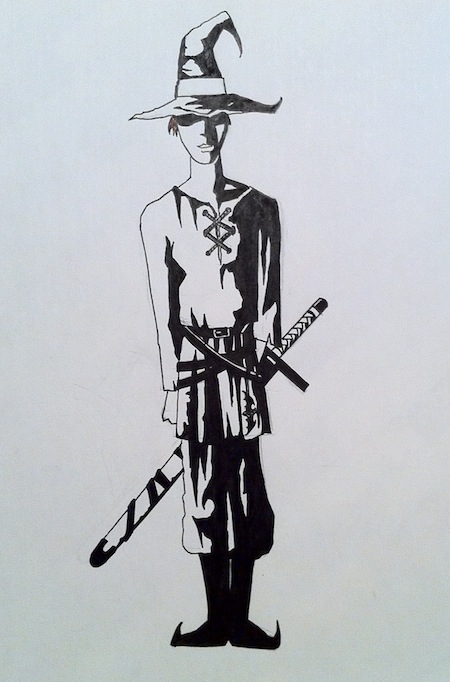
This was a picture I drew of a first-level magic-user. I don’t think he ever saw play. (Yes, that’s a sword. I don’t think he was very good with it. I have something of a tradition of making magic-users with swords, but not as awesome Jedi fighter-mage types. My longest-running character that I can remember was an elf wizard who was convinced he was a sword-master, and constantly had to be protected from himself by the rest of the party.)

One of my favorite parts of character creation is the illustration step. Sometimes, like in this case, I will draw a picture beforehand, as the inspiration for the character. Other times, the picture comes only after the character has been in play for a while, and has had a chance to develop a personality organically (and acquire some interesting possessions through play). I also like to draw NPCs, but that usually ends up being a bad idea, at least at the beginning, because then players assume that the NPC in question is important.

Sword & Sorcery

Creating a sword & sorcery genre atmosphere (or the atmosphere of closely related genres, such as sword & planet) is very popular in the OSR. This seems to be a common cure for the epic fantasy and adventure path malady which has overtaken much of the mainstream hobby. Just for a small sampling, here are few words from Grognardia on topic, and here is a fascinating discussion of alignment in the Conan stories from Blood of Prokopius.

When I was more enthusiastic about fantasy literature, mostly during middle and high school, I read some of the S&S classics, though mostly the ones that overlapped with dark fantasy such as Moorcock’s Elric novels. I avoided Conan, because the way he was portrayed in pop culture just seemed silly to me (macho barbarian hero fighting evil wizards and rescuing scantily-clad ladies in distress). I just finished the first of the 3 Del Rey compilation volumes (The Coming of Conan the Cimmerian); the original stories are a much more nuanced treatment of the conflict between civilization and barbarism than I assumed, though there is still some silliness of the aforementioned variety. I was also pleasantly surprised by the almost Lovecraftian treatment of many monsters, and the depiction of sorcery as inherently corrupt (in fact, I think this conception of magic is one of the major dividing lines between S&S fiction and the clearly described, almost scientific, “magic systems” of later fantasy, such as “channeling” in Robert Jordan’s The Wheel of Time).

As a young gamer, I did have some contact with the other primary source of the S&S genre, the Lankhmar stories of Fritz Lieber. I owned one of the AD&D Lankhmar supplements, and I think I read some comic books with Fafhrd and the Gray Mouser, but I didn’t read any of the original stories until a few months ago. I also just recently discovered and read the work of Clark Ashton Smith (despite the fact that I grew up near Auburn, California, where he lived, and despite the fact that necromancy has always been one of my favorite sorcerous archetypes). And I still haven’t read anything by Jack Vance, though Tales of the Dying Earth is waiting for me patiently on my bookshelf.

My point is that I did not really grow up with this genre, so I don’t feel much nostalgic pull toward it. However, I am sympathetic to its style, particularly for RPGs. The morality and goals of S&S protagonists seem to much more closely reflect the actual action of a traditional D&D game (tomb robbing, fortune hunting, mercenary work) than does just about any other genre of fiction. Really, D&D should have been called Get Rich or Die Trying.

I was just thinking about this again after reading this post from someone who is creating a retro-clone of 2E, and trying to infuse it with a S&S vibe. I don’t agree with all the elements from his list, but a few are spot-on, and exactly what I would love to communicate with my games: arcane magic is corrupt (following LotFP, in my setting “detect evil” and “detect magic” are the same thing), monsters are horrifying, ancient lost technology, monsters as gods.